Moon Letters
Moon Letters is a tool for creating fonts / glyphs / scripts for invented languages that can export scripts to OpenType fonts.

Something a bit different this time. Instead of a little experimental game Moon Letters is a tool for creating fonts / glyphs / scripts for invented languages. Or, I suppose, real languages, but it's not quite designed for that purpose.
I really enjoy games that involve constructed languages, especially where translating them is a central part of the game. Games like Chants of Sennaar and (the not nearly popular enough) Apothecary of Trubiz.
I've toyed off and on with the idea of building a game around this idea and one of the obstacles is – maybe unsurprisingly – creating a font for a non-existent language. Even if you aren't aiming for a "real" font in the sense of a TrueType or OpenType file, designing dozens or hundreds of letters or glyphs is no small task.
Moon Letters is a tool designed to help with exactly that.
It takes a bit of a non-standard approach to constructing a font: you begin by designing "root glyphs" which are collections of shapes split into segments. (For a simple alphabet just one root glyph might be sufficient, but there is no limit to how many you can build.) These root glyphs wind up looking something like this:
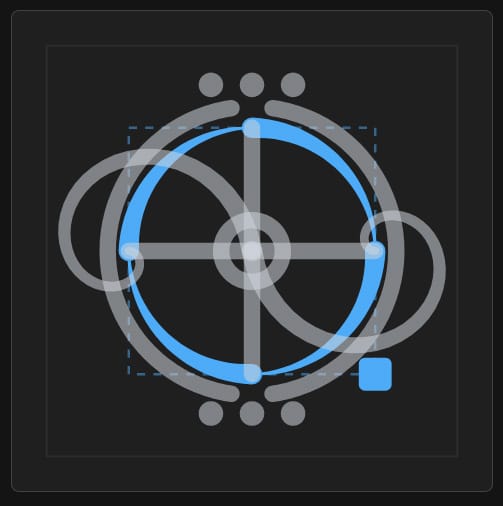
Once you have a root glyph you can create derived glyphs based on it. For each derived glyph you can toggle individual shapes and segments of the root glyph on or off. This makes it very efficient to create a writing system that shares lots of fundamental shapes or features.
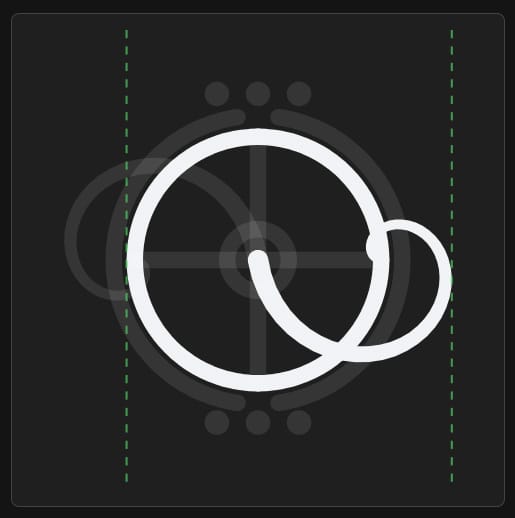
Thanks to Claude (primarily Opus 4.8) I was able to get a lot more features into Moon Letters than I expected; I had been planning on just the general idea of root glyphs with a couple of simple shapes, derived glyphs, and maybe SVG exports. Instead I wound up with a much more complete list:
- Root glyphs support a dozen different shape types, including free-form Bezier curves
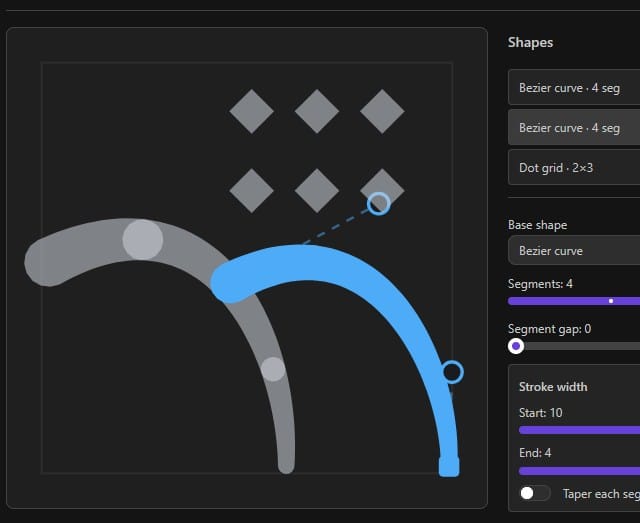
- All of those shapes can be subdivided into segments that can be toggled individually
- Shapes can be tapered either across the entire shape or along each individual segment
- Creating marks / diacritics is supported, along with some helper tools for using official Unicode combining characters if desired
- Ligatures are supported as well, so you can define individual glyphs that replace specific glyph sequences
- A live preview is available for the font at all times
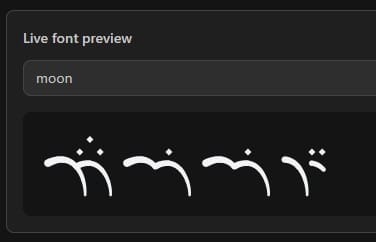
- Varying the advance width for each glyph is supported (so narrow glyphs are not surrounded by excess space from the root glyph)
- Composite glyphs can be created, combining multiple glyphs together in various arrangements (along the lines of how Hangul combines glyphs)
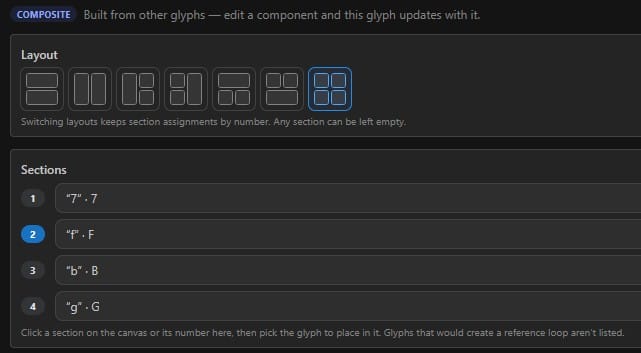
- Individual glyphs can be exported to SVGs, and the entire collection of glyphs can be exported as a proper OpenType font
- Multiple alphabets can be saved in local storage, and alphabets can be exported as JSON for moving them between computers
I haven't had a chance to build a complete set of glyphs for any particular purpose yet, but I'm hoping to spend a bit of time in that direction soon.
Oh, and once again the logo at top of this article is from GPT Image 2 on Leonardo.ai. (I'm consistently impressed by how good image generation has gotten at text.)