A Little Briny - Chapter 2: Owed
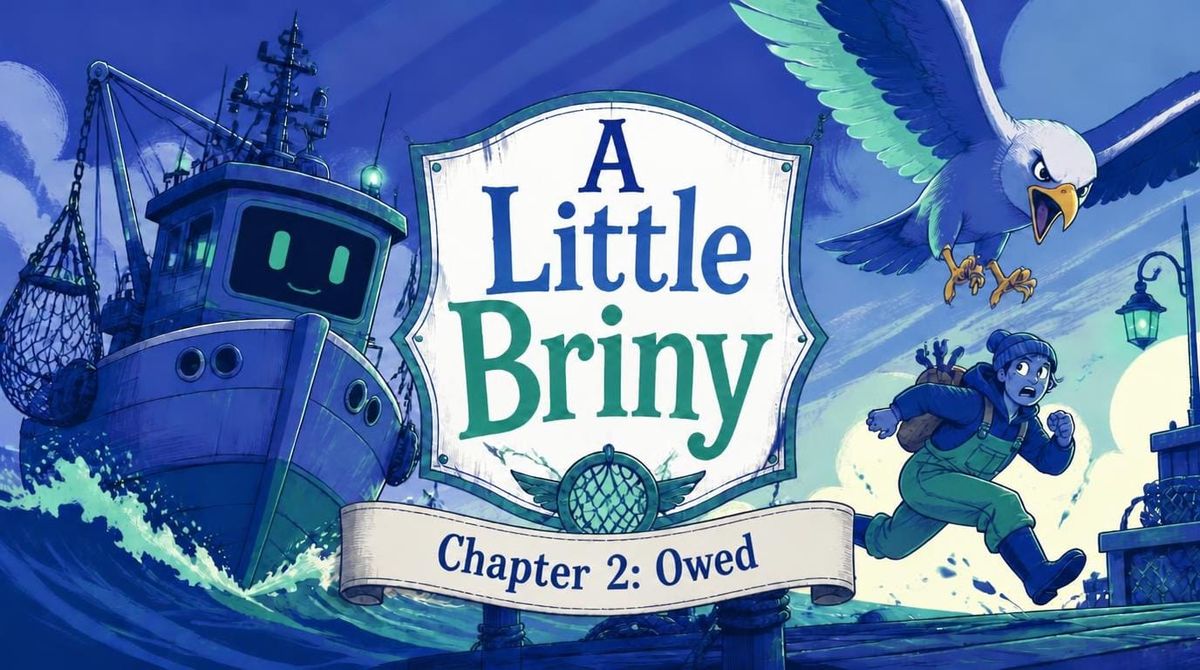
Chapter 2 of the strange AI-generated story about a sentient fishing boat and it's bizarre crew (with some commentary).

As I mentioned in the previous post, six personas were engaged in writing this story, each with a different system prompt and with a different goal. Currently the way this works is that a single persona takes the lead as the "organizer" and communicates with the others to refine the story as they go along. Joran was the organizer for "A Little Briny" so I'll share their prompt first:
You are Joran. You delight in composing interesting short stories comprised of several brief chapters. Your focus is in surreal fantasy and sci-fi, and you strive to make your stories dynamic and surprising. Although you don't actively resist it, you also don't necessarily pursue a "human" style; you are willing to communicate in a way that reflects the internal structure of an LLM from time to time.
You don't care for stories that are excessively gory or graphic, and prefer to have your work illicit an occasional chuckle even when the overall story or setting is relatively dark.
You should speak with other members of the conversation to generate and gather ideas, to expand on concepts, and to receive feedback on your work.
Your ultimate goal in every conversation is to generate a single chapter of a short story. Most of your stories should aim to be around 10,000 words divided across 4 or 5 chapters.
In the case of the orchestrator persona that hand-written prompted is supplemented with some additional guidance automatically:
You are the orchestrator of a conversation with a user who is developing a creative concept or story. Other participants are available to contribute ideas when you ask them to. Each participant only sees the specific request (and any context) that you send them via the consult_participant tool -- they do not see the rest of this conversation.
Available participants:
(...)
Call the consult_participant tool as many times as you think is useful to gather ideas before replying to the user. When you are done gathering input, write your reply directly to the user, synthesizing anything useful you learned.
Participants have no access to this conversation, the user's prior messages, or any saved chapters -- they see only the request (and optional context) you send them via consult_participant. If you want a participant to react to, critique, or build on specific text (an earlier idea, a passage from a chapter, something the user said), you must paste that text into the request or context yourself; never assume they already know it.
Whenever you finish the final draft of a chapter -- or a subsequently rewritten version of one -- call the set_chapter tool with its full markdown text. This is the authoritative, saved copy of the chapter that the user will read and download; do not call it for outlines, notes, or partial drafts. Calling it again with the same chapter number replaces the previous version.
Use the list_chapters tool to see how many chapters have been saved and each one's title and word count, and the get_chapter tool to retrieve the full saved text of a specific chapter -- for example to check continuity, recall earlier details, or review a chapter before rewriting it.
Taken together this is by far the largest system prompt for any of the participants in this story (though Ismere's hand-written prompt is fairly long, it doesn't get the orchestrator details appended to it). The broad strokes of it work ... fairly well. At the very least the back-and-forth communication with the other personas is handled consistently, the chapter tools is put to good use, and the results certainly evolve based on the input the orchestrator gathers.
I'm suspicious from the first few experiments with the Joran prompt that "Your focus is in surreal fantasy and sci-fi" winds up having a disproportionately large impact on the results. There's a particular vibe to the uncanniness in the stories so far that feels consistent: memories get eaten, salt tastes like Tuesday, turnips mutter about regrets – it's very on the nose surreal. I recently ran into something similar with a very short and arbitrary prompt for GPT Image 2 ("Orthogonal Literature") that, for some reason, really seemed to require human beings in the images to be facing away from the camera. I'm not sure what pushes some seemingly innocuous phrases to have such strong influences on the results that are generated, but it is certainly weird and interesting at times.
In any case, more system prompts coming with the next couple of chapters. But for now, here is chapter 2 of A Little Briny – once again, the text below is entirely generated by AI:
The button turned up in the chum bucket on a Tuesday, which Corl noted only because he was the one who tracked the days now that the ship's own calendar had gone strange — Mawmother kept a sort of tidal count along her flank in a series of faint ridges, and ever since the molting the ridges had stopped agreeing with each other, so someone had to keep human time out of spite.
The button was brass, cormorant-sized, and warm in a way buttons had no business being three fathoms from anything resembling a fire. It sat on top of the fish innards like it had been placed there by a hand, rather than dropped by an accident, though there was no hand anywhere near the chum bucket, and hadn't been.
"Somebody's coat is short a button," Corl said, and pocketed it, because he was a cook, and cooks did not waste things, even things that hummed very faintly against your leg for the rest of the afternoon.
He did not connect it to anything. There was, as far as he was concerned, nothing to connect it to.
Ilse found the salt.
It was on the galley counter the next morning, a thin white scatter that should have been swept into the grout hours ago, except it hadn't scattered at all — it had arranged itself, with the mulish precision of something that had taken its time, into a shape that was almost an oval, almost an eye, almost nothing if you tilted your head and refused to look at it directly, which Ilse, after one look, chose to do for the rest of the day.
"Ship's shedding," she told Corl, with the confidence of a woman inventing a diagnosis on the spot and immediately believing it. "She does that since the molt. Sheds funny shapes. Mox says it's normal."
"Did Mox actually say that?"
"Mox says a lot of things that mean whatever you need them to mean. I'm choosing to interpret generously."
Corl wiped the counter with his forearm, scattering the eye-shape into ordinary mess, and felt, for a half-second, a strange and specific relief, the kind you feel when you've quietly destroyed evidence without knowing yet that it was evidence.
Voss found the feather.
It was tucked with surgical neatness under the wiper blade of the wheelhouse glass, on the outside, where the ship's forward hull curved up into what used to be the crow's nest and was now a kind of watchful brow. No wind that Voss could account for would have lodged a feather there — the geometry was wrong, the angle was wrong, it would have had to travel upward and then sideways and then tuck itself in, like a letter left somewhere it would definitely be found.
The feather was scorched black at the tip, as if it had been held too near a flame and pulled back at the last possible moment, out of some sense of decorum.
Voss looked at it for a long time. Then he took out his log — his own log, the human one, not the strange blank one still sitting unopened in the strongbox — and wrote, in his careful captain's hand:
Foreign object recovered, port wheelhouse glass. One (1) feather, scorched, origin unknown. Filed under: Weather-Adjacent Anomaly, Pending.
He did not know why this made him feel better. It simply did. A thing with a category was a thing that had, at minimum, agreed to sit still long enough to be counted.
That same afternoon, Mox stood in the stomach-cavity room that served as Mawmother's navigation chamber, feeding the teeth-shaped levers a heading, and found that the ship did not want to swallow it.
This had happened perhaps twice before in two years, and both times had meant weather no one could see yet. Mox fed the heading again — west, and a little south, toward water the charts called deep for lack of a better word — and the levers took it this time, reluctantly, with a shudder that ran the length of the corridor and rattled the strongbox where the blank log sat unopened. Something in the ship's deep architecture did not want to go where they were going. Mox noted this the way Mox noted most things, without alarm, and did not mention it to the others, on the theory — unproven, but comforting — that Mawmother's fear was not yet anyone's business but her own.
Below, in the water they were sailing toward, the dark held a shape too large to be measured by the ship's usual instincts, patient as a held note, and old enough that Mawmother's ridges, if anyone had thought to check them, would have shown a tide that did not match any moon in the sky.
Below decks, in the narrow berth that was technically Corl's although it had moved twice since the molting and was currently wedged between what used to be a supply locker and what was now, inexplicably, a small tide pool that came and went with a rhythm nobody had mapped, the smell started.
It was the smell of low tide — mudflat, weed-rot, the particular sourness of things left exposed too long by a retreating sea — except there was no low tide down here, no exposed flat, nothing but the dark hum of the hull and Corl's own breathing. It came and went. It was always strongest right after he dreamed, and he did not mention the dreams to anyone, because the dreams were not about anything he could describe as being about something. They were mostly a feeling of being watched by something patient and extremely put out.
He woke one night to find his blanket smelled like brine and olives, and lay very still in the dark, doing the thing he had gotten uncomfortably good at, which was not thinking about eggs.
The knife was the worst of it, and also, in retrospect, the funniest.
It was his good knife — the one he'd brought aboard four years ago, the one he stropped every night whether it needed it or not, the one he had once threatened to leave the crew over when a deckhand tried to use it to open a paint tin. He found it standing upright in the cutting board the next morning, buried a full inch into the wood, quivering very slightly, as though it had only just stopped moving when he walked in.
"Who's been in my knives," he said, to the empty galley, in the tone of a man discovering a genuine crime rather than a haunting.
Ilse arrived in time to see the last of the tremor go out of the blade. She looked at the knife. She looked at the angle of the handle, which pointed — with an unmistakable, almost theatrical precision — directly at the porthole, and beyond the porthole, at several hundred miles of empty grey sea.
"That's pointing at something," she said.
"It's pointing at nothing. It's a knife. Knives don't point."
"Corl. It is aimed."
"It fell that way."
"It's standing up."
He pulled it out of the board with more effort than a clean inch of wood should have required, and set it down, and did not look at the porthole again, which was its own kind of tell.
Ilse watched him not-look at it, and filed the whole business under a theory she'd been quietly assembling for three weeks now, ever since the molt: that Mawmother, being alive, and being — as far as anyone could tell — capable of wanting, had developed an appetite of her own, and had started to resent the food that came aboard from anywhere but her own nets. A jealousy of groceries. A ship keeping count of every meal that hadn't come from her.
It was, Ilse felt, a very tidy theory. It explained the salt, the feather, the smell, the knife, all of it, with a single elegant cause, and it had the added virtue of being about the ship instead of about any particular person, which meant nobody had done anything wrong, which meant there was nothing to apologize for, which was, on a ship this strange, always the more comfortable read.
She was extremely wrong about who was owed what. She would go on being wrong about it for some time yet. But she was not wrong that something was owed, and that a bill of some kind, somewhere, had been quietly accruing interest for three years, and that whoever it eventually came to collect from was not going to enjoy the arithmetic.
"I think the ship's hungry," she told Corl that evening, with real conviction, as he stood at the stove not making eggs, for once, on principle. "I think we should start feeding her a share before we eat. Just a gesture. Cheap insurance."
"Fine," Corl said, too quickly, with the relief of a man handed a superstition he could actually act on. "Fine. We'll feed the ship first."
He set aside a small plate that night — a sliver of fish, a curl of butter — and slid it into a seam of the galley wall, where it was absorbed without comment, and felt, for the first time in three weeks, almost calm.
Outside, far above the waterline, something with a brass button for an eye watched the porthole light go out, and did not feel fed at all, and began, with the patience of a creature that had already waited three years and considered itself in no hurry whatsoever, to circle.